Reimagining career development with AI
Udemy Career Hub
The original brief called for a static landing page. I reframed the engagement into a fully interactive product prototype.
20+ high-fidelity screens · 3 guided user journeys · AI-powered personalization concept
From Course Marketplace to Career Platform
Udemy wanted to develop an experience to set them apart and leverage their business partnerships.
Role
Senior Manager, Conversion Rate Optimization
Focus
Product Strategy · UX Research · Information Architecture · Prototyping
The Brief
Udemy approached Brainlabs with an opportunity to rethink how learners discover and commit to a new career path. The original scope centred around a static landing page that would introduce the concept of a "Career Hub" and encourage users to explore curated learning journeys.
After reviewing the brief and speaking with stakeholders, I felt the challenge wasn't visual design or content; it was product definition. The team was still working through fundamental questions around audience, navigation, and feature priorities. A polished landing page wouldn't answer those questions.
Instead, I recommended we shift the engagement toward a fully interactive prototype that gave the team a concrete product direction to evaluate, test, and build from."
The Problem
Very quickly, a few themes began to emerge.
Some stakeholders imagined a destination for users who already knew what they wanted to become. Others believed the experience should guide people who had no idea where to start. There were also open questions around personalization, course discovery, and how AI could play a meaningful role without feeling forced.
The project wasn't suffering from a lack of ideas. It was suffering from too many good ideas moving in different directions. Leading to conflicts and a “good enough” implementation which led to poor engagement and increase bounce rates.
My Approach
Rather than designing screens immediately, I focused on creating a framework that could bring the experience together.
I consolidated stakeholder feedback, identified recurring patterns, and looked for the underlying user problem the team was trying to solve. That led to a simple observation:
People don't just need help finding a course. They need confidence that they're heading in the right direction.
That insight shaped the entire experience.
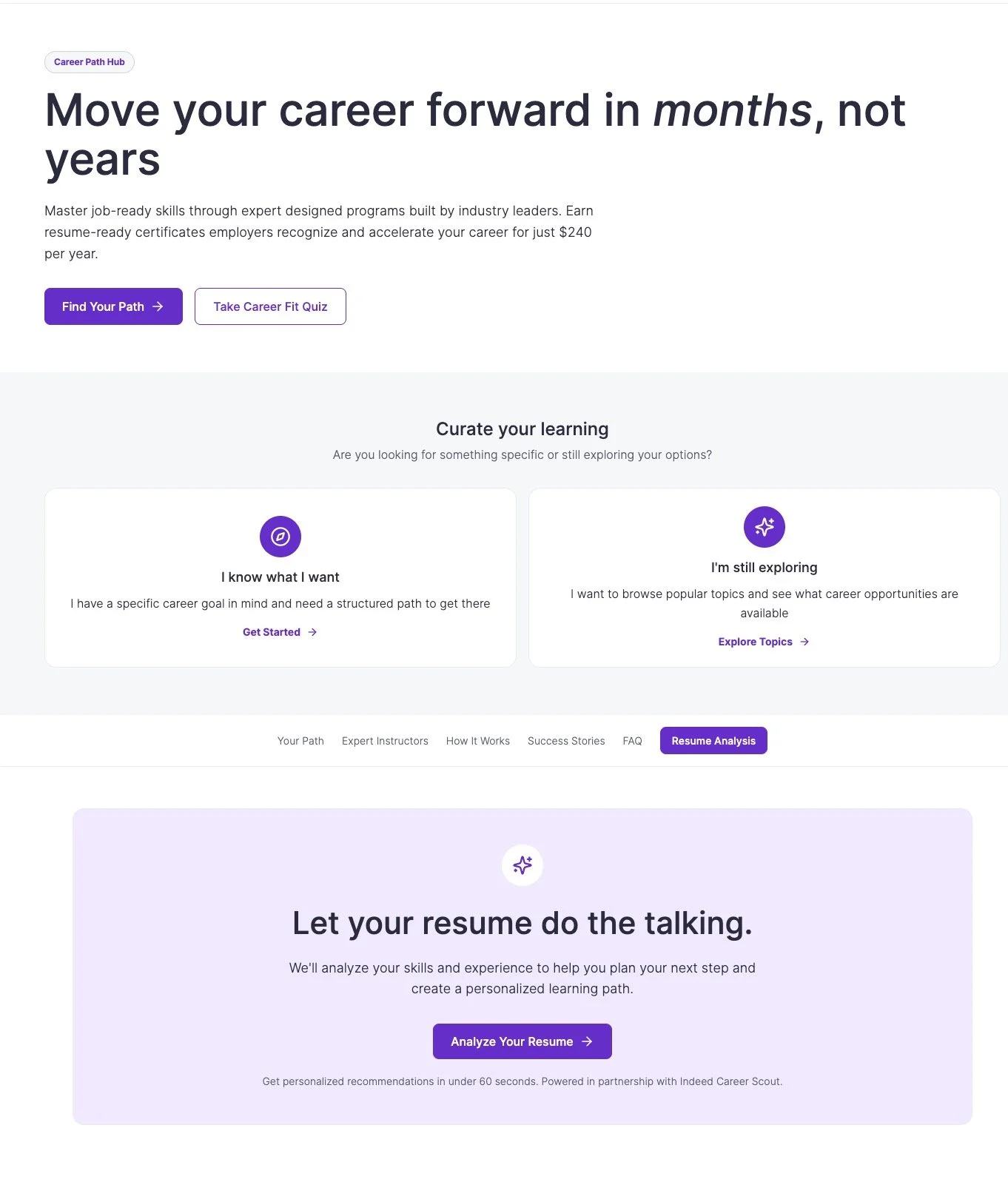
I introduced an Intent Gate that separated users into two paths:
I know what I want — for learners with a clear destination in mind.
I'm still exploring — for users looking for guidance before making a decision.
From there, I designed a complete Career Hub prototype that repositioned Udemy from a course marketplace into a guided career-development platform.
Designing the Experience
The prototype explored the entire user journey, including:
A redesigned Career Hub landing page.
Guided entry points based on user intent.
A scalable Topics & Skills discovery model.
An AI-powered Resume Analyzer concept.
Comparison and trust-building modules.
Social proof, FAQs, and conversion touchpoints.
One of the biggest changes was replacing the original "career accelerator" bundle concept with a more flexible Topics & Skills framework that better reflected Udemy's content ecosystem and could grow over time.
I also introduced the idea of an AI-powered Resume Analyzer. Rather than simply recommending courses, the feature was designed to help users understand how their existing experience aligned with a future role and identify the skills they needed to develop next.
The Outcome
The final deliverable was a fully interactive Figma prototype that gave stakeholders something tangible to evaluate and build around.
More importantly, the engagement evolved beyond its original scope. By replacing a static landing page with a prototype-led process, the work helped clarify the product vision, align competing perspectives, and establish a foundation for future user testing and development.
Reflection
One of the most valuable lessons from this project was that the requested deliverable isn't always the right one.
Sometimes the best design decision happens before a single screen is created. In this case, the real contribution wasn't building a landing page, it was recognizing that the team needed a way to explore, test, and align around an idea before committing it to production.
That's the kind of product design work I enjoy most: taking an ambiguous problem, finding the right level to solve it, and turning uncertainty into something teams can actually build from.